

To help consume this topic easily (and also because I want your attention on every single word that I say going forward on this Substack, and I know you’ve sold it to the internet demons), I’ve broken this post down into two parts.
the first post (this one) talks about how one earns the right to comment on stuff they say on the internet
the second post (coming on the upcoming weekend) talks about the current state of affairs, and how is AI helping us clear the fluff
If any of the two takes sound interesting to you, you should definitely consider subscribing to this newsletter for more. We’re just getting started.
These days, I start my day early, taking my own sweet time to get ready for work. I only open my laptop when I arrive at my office at around 10-11, and keep slogging till the end of the day till my brain can’t take it anymore. This is when I typically head out to the gym, and come back only to find myself hooked to the “boring black screen”1 once again. I’ve never felt closer to being a computer geek, and frankly, I’m having a blast doing it!
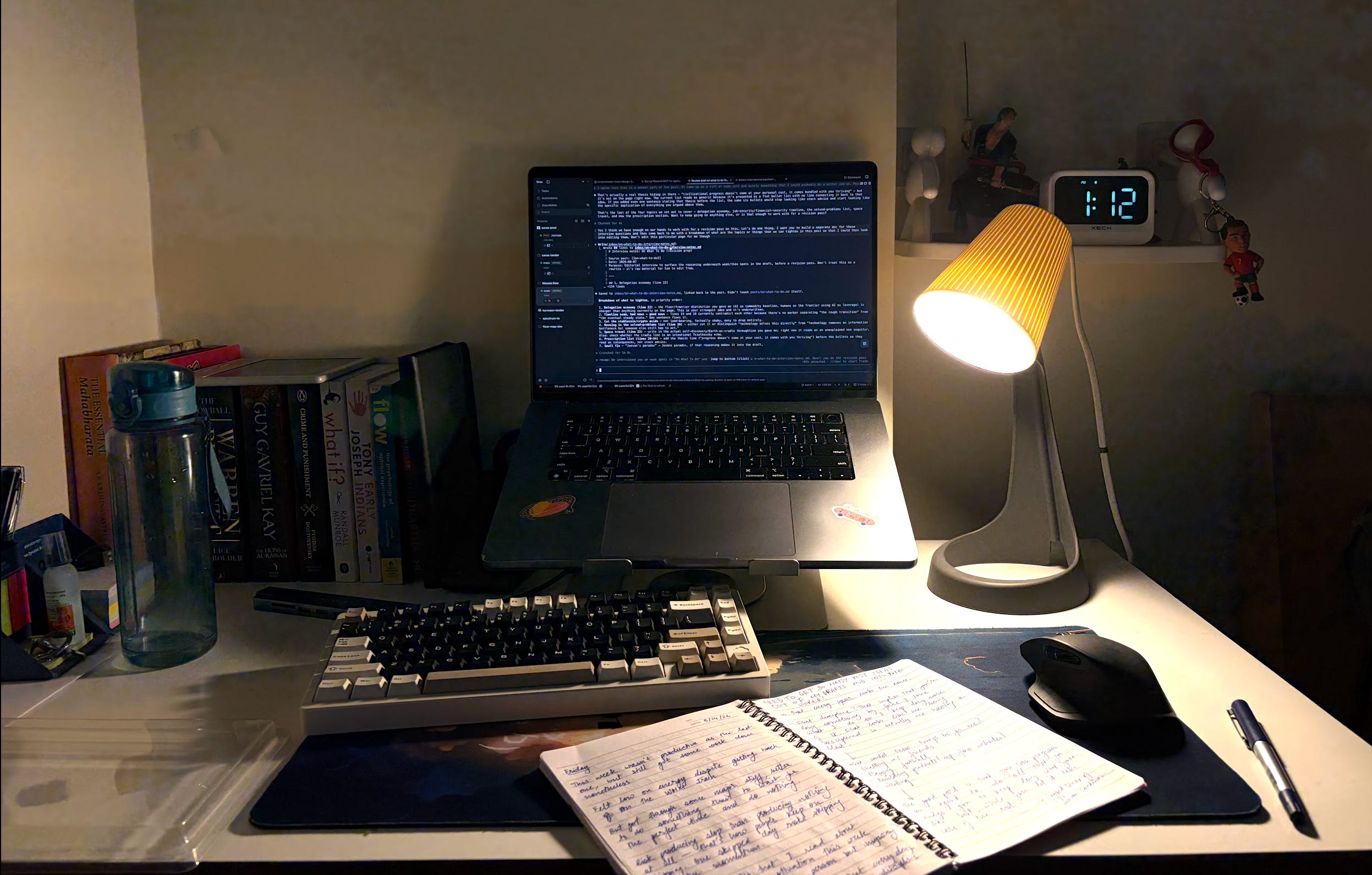
But there comes a point where I just am too tired to move a finger, or even use Wispr Flow to dictate ramblings and prompts to my agents, which is when I would just spend time grazing through my Substack and X feeds as though I’m collecting pebbles on the shore of a river2.
In this madness, I have (re)entered into the rabbithole of Steve Jobs archives. Long lectures and keynotes from the 80s and 90s, blogs, historical emails and ofc the occasional short videos that every platform tends to hurl at me.
One of these insights really stuck with me and I’ve been thinking hard about this for some time.
This came in as a reassuring take as I’ve increasingly seen people go the opposite way, and have always doubted myself.
We’re often told that the act of building and the act of thinking about what to build are two separate crafts, which is why you have the PM and the engineer, the autistic tech co-founder and the ADHD business co-founder, the Batman and the Robin, the accelerator and the brake – you get the point, right?
But Jobs proclaimed the opposite. In his view, the builders get to earn the right to be intellectual only after they’ve been in the trenches and have done some building themselves. From a common sense perspective, that also seems true.
But upon thinking a little further, I came to a conclusion that both of these perspectives are true. The important nuance is when these happen. The policymaker is a policymaker today, but to be the best in policymaking she should also have had some experience of doing the dirty work that her policy affects. The head chef in a kitchen started out by sweeping floors first.
It’s just that in the age of AI-assisted knowledge work, these timelines are starting to merge. The act of learning and the act of graduating are collapsing into each other.
What Jobs meant to say, at least in my view, was that you can be a commentator on technology, culture, business, spirituality and what not if you have lived the reality of what you’re saying yourself. Building something requires a real intellectual lift that ironically, purely intellectual work cannot provide.
That also doesn’t necessarily mean that you may be doing these things together at the same time. We as human beings are limited by the number of things we can pay attention to at any given point in time. Which is why we may actually be served better if we decouple the thought of why we are building from how we are building, hand it over to different people, or if time allows, make the same person go through the entire ordeal themselves. Our limited attention is why we hire for more people, and will keep doing so as businesses grow and expand.

Which is why great operators become great investors3, and why the best tech commentators on Substack4 and the people who write the best essays on public policy5 have been through that rite of passage themselves. It’s kind of obvious but you can’t develop insight through summaries, or any form of such secondary research. Lived experienced is us taking in the world, not only through our eyes or ears, but through all the senses all at once, for a reasonably long period of time. All that calcifies to become insight worth sharing.
This also means that if you want to be heard, you need to become worthwhile of saying it.
We have become so attached to the modality of “knowing something” just by watching videos (or worse, reels) that we fail to remember that photos and videos were always meant to be “images” of the broader human experience. Which is also why text, as ironical it is, often is a better medium to propagate insight as it doesn’t have to be contained between two black bars of the right aspect ratio or the right kind of colour grading. Paper as a medium is often touted to be indestructible and old books tell tales about forgotten civilizations even today.

That is not to say that videos are useless. They are a high bandwidth medium for consuming any kind of information and justify their commercial success very well. As much as I laud text for being THE medium I also know that my mom doesn’t read my essays but she raves about any videos my brother or I post on our social media, even if she doesn’t get it at all. It’s just that you may conflate the medium with the message because of the commercial success of something which is the equivalent of eating mud wrapped in chaandi ka warq. What’s most popular is not always correct.
Which is also why, for the longest time I’ve held back from posting sharp takes about a lot of things that I felt strongly for. At least that’s how I rationalized it in my head. Not sure if holding back has served me well though in an age where people are spinning up personal brands on LinkedIn and earns lakhs in their early twenties through repeated playbooks. Whatever sails your boat, I guess. And it’s almost never a bad thing to earn well if you can.
However, my last four years in my PM stint (and an almost vertical learning curve) + my recent founder arc have borne me at least some “experience capital”. Going forward, I expect to be able to cast much sharper takes and make evocative statements while still being authentic and not sounding like a ragebaiter picking a fight to serve a merciless algorithmic god while risking my credentials for a few likes and a monthly payout over X.
One such example is how Facebook is probably the worst tech company to be born in the best way possible. My urge to write anti-FB posts has been as old as my desire to build this newsletter. But only now am I convinced that I certainly won’t be selling my soul working for the company as a PM. That offers me the leeway to write what’s on my mind about Facebook and the precedent they’ve set in the corporate tech scene.
In a fast-changing world, it becomes more than important than ever to bring in unique takes. Most of what you may be sharing might come off as a response to a ChatGPT prompt. Think about what is it that you know that the LLMs don’t – the answer often lies outside the screen.
In the next part, we’ll go further into why AI is changing this landscape quickly, and how can it actually be good news for genuine creators and the sincere consumers. Stay tuned!
Cheers,
Samyak
I fondly remember this term as our computer science teacher was introducing it in our classroom when we were learning terminal commands in our little chapter dedicated to Linux. My school had a lot of interesting courses which failed to develop much beyond a punchy introduction to some of the coolest topics in STEM.
This is just a simile, and definitely not me endorsing bookmarking tweets over collecting pebbles.
Speaking of investing, my dad has been a champion operator all throughout his life. Which is why when he started Hawkeye Capital as a nobody in the financial industry, some of the tycoons in the industry (including the likes of an ex-COO at Vodafone, ex-CEO at Tata Teleservices, dignitaries in the IAS and even Bollywood actors) believed in what he said, and most importantly, what he delivered. If you’d like to learn more, head over to hawkeyecapital.in and get in touch!
some of my favourites operators/writers on Substack:
Pranay Kotasthane is a personal fav. Been digging his new pod with Amit Verma and Shruti Rajgopalan.
Nice read✨
hard agree on ppl need to get “experience capital” before commenting their views :)