

This is the second part in the two-part series about earning the right to say. This one’s about how AI is affecting the world of “hot takes” and rage baits (man, I’m spitting bars atm).
For the first part:
“Samyak, could you please do a favour and leave AI out of this conversation for God’s sake?”
No.
It’s important to talk about this because (a) it’s fun (b) it’s pretty relevant and (c) it helps me build a circle of interesting people who “get it” and possibly boost my subscriber count.
Are you one of us?
We’ve seen social media getting used, misused and reused for that perennial “content creator” who makes a living out of sharing takes, often very polarized, for the sake of raking in views and followers. To be fair: not all creators are rage-baiters or trend-chasers. Some social media platforms endorse ragebait more strongly over others, then too for some specific content categories.
This category of creators is not the kind who shares optimistic white-pill tech stories like Caleb Friesen or Cleo Abram, or honest personal takes honed after years of their expertise from folks like Ken Sakata or Kun Chen.
This is a special category of devils who get a kick out of spreading FUD (fear-uncertainty-doubt) or build a following out of sharing recycled takes in their own name and post a million times about them in a format that allows them to hijack the algorithm in their favour. The hijack is done on very humanistic terms, though.
They will start their post with a siren emoji and claim that the world is going to end and there’s only one way to save it. They will provoke public by taking one comment from one individual out of context, and go after entire groups of people. The content that “performs” the best these days takes the least amount of brain cells to process and leaves you feeling bloated in the brain. The more the bloat, the more you’d bleat. 🐑
But something interesting is happening. The AI algorithms that helped them rise up the ranks are being countered by this cesspool of AI-generated artifacts that quickly kills trends and gives way to original takes and direct creator-follower relationships.

Didn’t follow me? I’ll start again.
There’s a reason why negative news spreads faster on the internet. The reason is pretty simple: natural selection. Our ancestors were wired to spot threats, negativity, fires and scarcity before they appreciated the jungle for its giant trees and clear night skies. This simply helped them survive and pass on their progeny, as is the biological goal of all living species on this planet.
The creators on these platforms, and the platforms themselves understand this far too well. You’ll often come across ragebait headlines (”X should be wiped out of existence”), distracting reactions and visuals as overlays on the main content, overly colourful subtitles, podcast mics in front of creators (to command credibility) and even highly-saturated colours (with weird red-looking skins). In other words, these creators have learned the tricks of the trade and are able to hold their audience and their attention hostage. Some things just plain work on everyone and you really can’t help it if you’re human.

Negativity drives more engagement for the platform on one end, and keeps the creators suitably rewarded and hungry for more. This is not exactly a win-win either. What creators make is what they take away from their users – attention. Captive eyeballs and soggy minds, who lose their sleep over the state of the world and their own miseries.
A lot of these posts are created by “experts” whose expertise stems from the “research” of a single 10-minute video essay. Or worse, a 10-second Instagram reel. Vanity theorists and armchair activists, minting posts and brewing circular arguments, acting up as though what they said is not being echoed by a few hundred others like them.
The AI algorithms pick this up, neutrally. They don’t care about the commentator’s credentials, but only their hot takes and the reactions driven by them. This gives these creators social and financial incentives and the cycle continues.
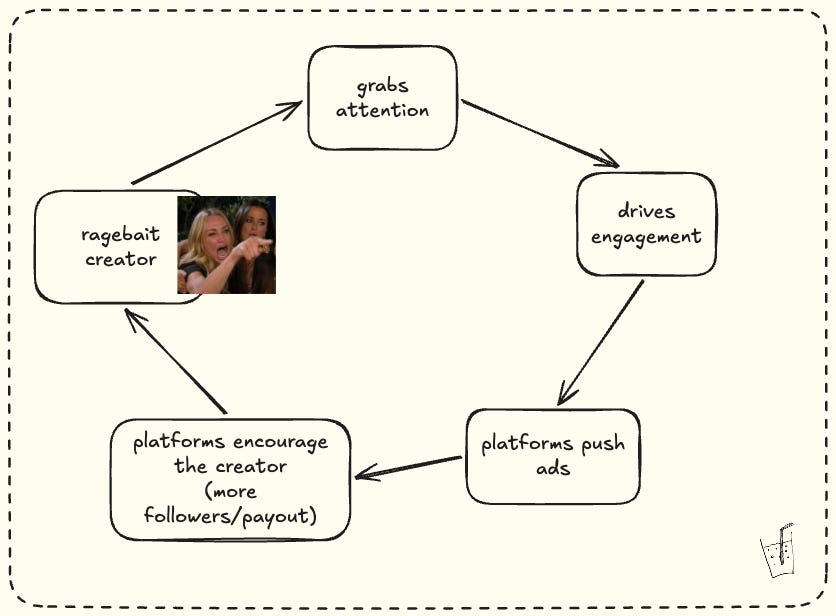
Content which is meant to “light a spark” generates emotions and rails off any possibility to introduce logic. The conversations erode and the audience loses the plot.
The recent NEET upheaval is a textbook example of this behaviour. The conversation, which should’ve unequivocally been about how to improve testing standards in national exams, got littered and dominated by how Gen-Zs are a threat to the nation or how the ruling party is a threat to democracy. Who cares about exams anyway?
If this is any respite, it’s not exclusive to India. We’re seeing this trend across the world. There was book written on this topic (which I’m yet to read) called ‘The Death of Expertise’ by a writer whose columns I’ve enjoyed in the past (Tom Nichols). The book essentially talks about how information is conflated with insight and how armchair activists pose themselves as experts on topics through a summary which is now even easier to obtain through ChatGPT.1
The problem is that the playbook is now obvious to a lot of struggling creators and they have to lean on being unauthentic and sometimes resort to all sorts of baits to be successful in this game which gets difficult every single day.
Now comes the fun part.
There’s the famous saying in Hindi, “Zeher hi zeher ko kaatata hai” (Poison poisons the poison). My hopeful argument in this post is that we’re at an interesting inflexion point, from where we’ll see a sharp reversal in these consumption and creation trends. There are a bunch of factors at play, and AI is at the heart of it all.
The reversal of incentives
When people just started hanging out online, serving ads along the margins of your 4:3 CRT box was the only good way to monetize your website. Shove a few ads, and you’d at least be able to pay back the server costs if people enjoy reading your blogs.
But soon enough, people started getting tired, just too damn tired of ads. They started seeing it everywhere, and platforms made sure they did. There came a time, not too long ago, when users were given an option to opt out of that experience for a small fee. As they found comfort in hanging out online, largely thanks to easy internet access through mobile phones and easier ways to pay, they loosened up to the idea of getting out of this cesspool of ads through a small subscription.
Platforms started adapting to this reality. Direct cut off subscriptions like how Substack does it, now seem like legit ways to monetize at scale. The 1,000 true fans vision put by Kevin Kelly in the 2000s is actually becoming increasingly real.
Premium subscriptions to AI tools like ChatGPT – which rely on token spends – have loosened hands even more. The average developer is spending in the range of a few 100s of dollars every month to get large parts of their job done.2
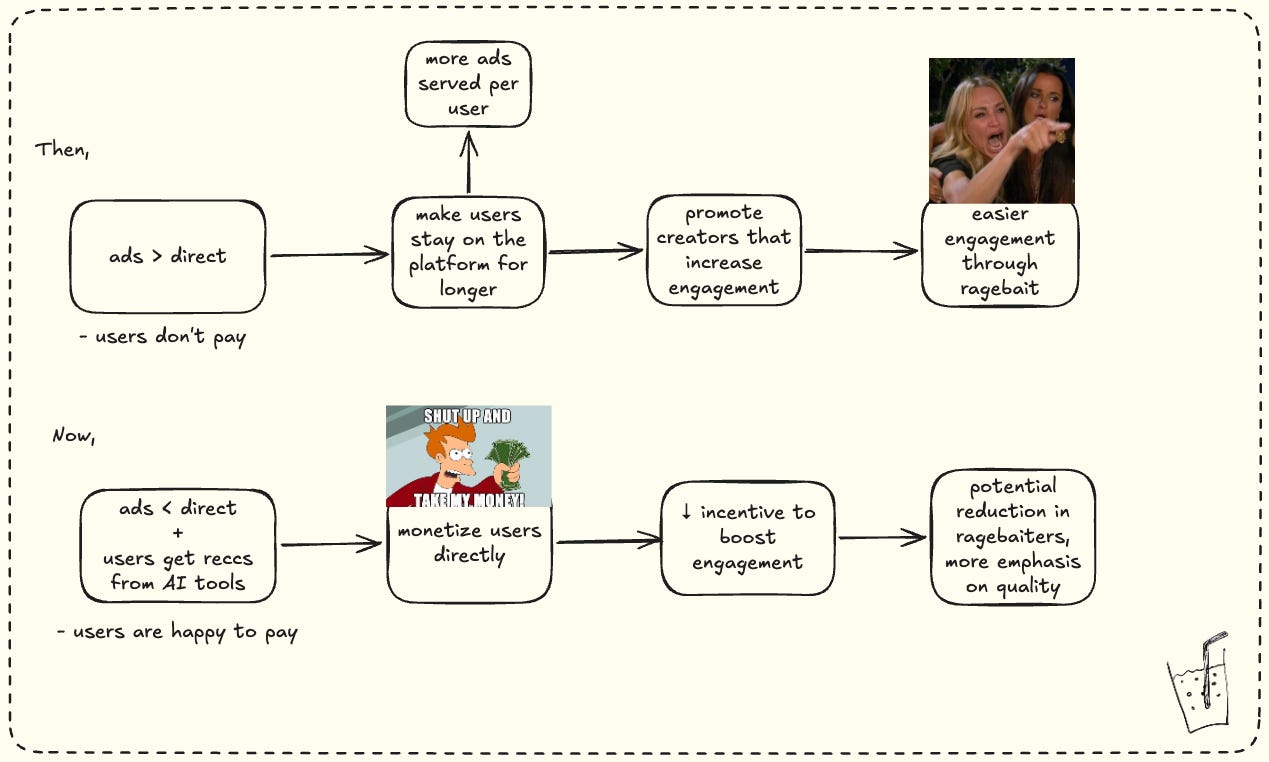
My little prediction: it would be much less friction for any online product/service to monetize their users directly. Going forward, people would be much more keen to pay for stuff online.

Any business behaviour is shaped by who is paying for its services. Meta has pre-dominantly been an advertising company selling its ad space to brands that can sell themselves. Therefore it works for its customers (brands), and do the bare minimum to keep their users on the platform. But in a parallel universe, if users somehow end up paying nearly as much as brands pay Meta, then Meta starts working more for the users.
After all, the money you pay is not only a source of revenue/survival for a company. It is also a vote for its very existence, which signals what should be produced more of in a capitalist world. And that’s not necessarily things that scare or depress you.
Moreover brands, who have a finite ad budget to spend in a year, may find it much higher ROI activity to monetize over newer channels like ChatGPT, which could expose them to their users directly. If they have a $100 to spend on customer acquisition, they’d spend a majority of these on a place which gets them more users.
This is the same phenomenon through which brands moved out of print media and into social media. Now we may see this happening again, brands moving out of social media into advertising over the question/answer space where higher-intent users hang out.
This seems to me partly the reason why Meta is also spending a bomb on AI infrastructure, having acquired scale.ai and it’s super-talented team, building their own class of open-weight LLMs (Llama, Muse) and coding harnesses. They’re probably sensing a shift in demand, and a threat to their core business model. And they know that they need to hurry up.
All of this means lower incentives to push ragebait (which people are getting tired of) and incentive to push stuff to the feeds that people would pay for.3 OnlyFans Substack has probably been the most successful recent example. Once a loyal fan subscribes to their favourite writer’s OnlyFans Substack, everyone is happy. OnlyFans Substack earns off a %age of their creator’s revenue, the creator gets paid and validated directly by their viewers readers and the readers get to back and enjoy what they came for.
(no pun intended)
All of this may mean lesser ragebait, less reactionary content as there are simply small incentives for the algorithms to put such stuff across to you.
To sum everything up…
The floor is lower, but the ceiling is higher
In a world where everyone writes polished texts and builds beautiful word salads, who would you trust?
Have you seen creators mumbling the same AI tells, the same hot takes (doesn’t that make it lukewarm then?) on your reels recently.
“It’s not X, it’s Y”
“Here’s the best part”
“No X. No Y. Only Z.”
That is because IT IS convenient to generate a script instead of writing your own. This is not limited to video scripts alone. The videos themselves are either using the same format of a hundred cuts in the same 10-second video, or have AI-generated clips meant as B-rolls.
That weird fisheye caption font (I hate it), that same oft-repeated dialogues. The same POVs, the same memes. The same kind of trends which rot every week, giving rise to a new one.
This is because the most popular AI tools triangulate towards the same creation recommendations for all creators who use those tools. As a creator who wants to mint as much content as possible to please the algorithm, nothing is stopping you from using these AI tools to mass-produce content.
The result? The same shiny, polished stuff. Content creation at industrial scale. But no warmth, no personality. Only what “performs the best”.4
The more your audience sees such repetitive shit, the more pissed they feel. As someone who talks to agent as his full-time job, I’ve unconsciously developed the ability to guess which model was used to write which sentence in any given LinkedIn post.5
Now, when everyone can do it, the value shifts upward. Nobody cares for your word salads because they can make one themselves at home.
I saw a very interesting graph recently.
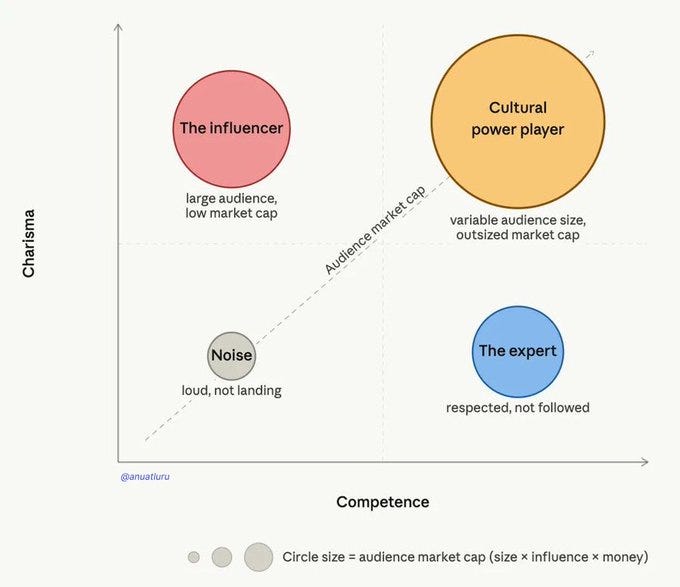
This gave me a lot of hope!
Everyone who dreams to be an influencer, which in today’s age has increasingly become an act of instigating offence are being challenged by people who wield better tools. Fake influencers drawing fake likes and fake reshares by fake followers. They started rigging the game so much that the system imploded.


The creators who farmed charming aesthetics are being challenged by machines who create even more charming stuff. The machines can manufacture this at a scale that humans can’t keep up. Who can (humanly) create 10 high-quality reels a day from different locations for 365 days a year without burning out?
The point is: everything looks the same. What remains? Original takes by people who’re awash with experience. The surface-level studs who used to rule the world by hacking and reverse-engineering AI algorithms with polish are being challenged by another class of AI systems. Katai zeher!
Combine the point above (direct over ad-powered) and the fact that everyone can now create and this is what you’ll get:
The people who have the right to comment will naturally be rewarded. The world will care less about the perfectly-constructed sentence and will care more about unique value. When everyone can create, quality will come out on top.
What gets you higher quality?
Having been there, done that. Sharing ground-level insight that ChatGPT summaries can’t teach you. Building the kind of competence that would take you years of focussed practice. even if theY come in PooRly ConstrUCcted sentencesess, they should stand the test of authenticity if they’re simply legible enough.
And most of all, when everybody does create, you’d find less “celebrities” and more people living a good life with their 1,000 true fans. These people will have lesser reasons to succumb to the algorithm once they’ve built a baseline level of trust. Trust and depth will help you go more direct with your followers and build deeper relationships with them. This post by Fatema Raja is an interesting foray into the dominance of craft over reach.

Well yes, it’s good news – but nothing more than moderately-probable scenario. The trendlines do seem hopeful though.
And that, kids, is how I met your mother how’s social media changing, for the better imo. Also why you need to walk the walk before you can talk the talk. No shortcuts anymore, only nice, long, fun trips in this journey called life.
This came out to be a bit longer than what I expected. But if you read this all the way to the end, then you’re a shining ray of light and the world needs more people like you. Or at least I do!
Let me know if you agree or disagree to my little “hot take”. I’d call it a “chill take” because it nothing groundbreaking, just reassuring. Whatever you feel about it, I’m happy to know more about it!
Thanks for reading it all the way to the end though. Much appreciated!
Cheers,
Samyak
yes, I know I’m awfully close to being a hypocrite here. I’ll get to read this book very soon!
not-so-breaking-news: solo developer burns ₹10k a week on AI tools alone, prolongs hiring his first employee cuz he’s broke af T-T
this is an oversimplified take of this phenomena, and I can talk more about this in detail in some other post maybe
see what I did there? No I didn’t use Claude, I wrote it myself hehe
you guessed it right; most of it is Opus 5 slop these days. I’m pretty sure we’re headed towards a GPT-5.6 trend soon